

 consultation
More knowledge.
More SAP power.
More SAP power.
Register now for free and receive smart tips on output management, SAP forms, customizing, webinars, and more once a month!

From 2027, e-invoicing will become mandatory for many businesses. Find out who is affected by the new regulations, what the deadlines are, and how you can prepare your SAP environment for the changeover in good time.
On 1 January 2027, an important transitional arrangement regarding the obligation to issue e-invoices will come to an end for many businesses in Germany. Whilst the issue has been developing gradually since 2025, things will become serious for numerous businesses in 2027. Any business that generated a turnover of more than 800,000 euros in the previous year will be obliged to issue e-invoices in a structured format in future. A simple PDF will no longer suffice.
For companies with SAP environments in particular, this means more than just a new file format. Invoicing processes, interfaces and master data must all work together to ensure that invoices can be created, sent and processed in accordance with the law.
In this article, you will find out which rules will apply in 2027, who is affected by the e-invoicing requirement, and why SAP companies should start preparing now.
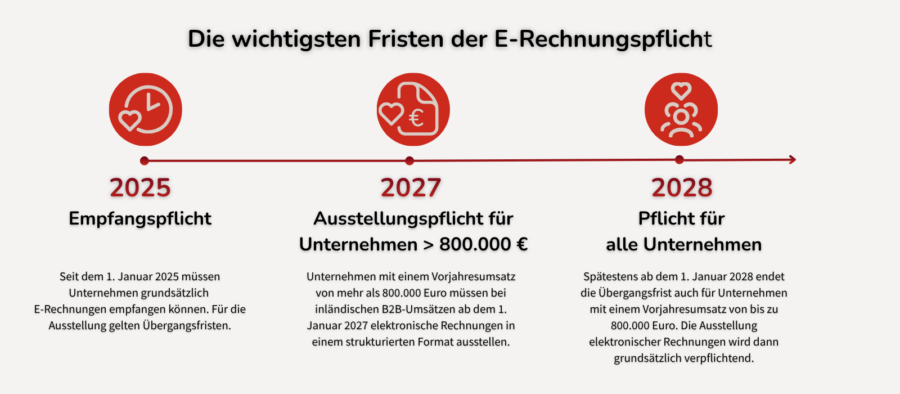
The Growth Opportunities Act has seen the gradual introduction of electronic invoicing in the B2B sector. The aim is to digitalize invoicing processes and, in the future, to enable an electronic reporting system for VAT data. Since 1 January 2025, the use of electronic invoices has generally been mandatory for transactions between domestic companies.
However, transition periods apply to the issuance. The definition of an electronic invoice is key here. Many companies still rely on PDF files sent via email. According to the new legal definition, however, these are no longer considered e-invoices. An electronic invoice must be in a structured, machine-readable format.
This is the only way ERP systems can automatically process the content. Suitable formats include, for example, XRechnung or ZUGFeRD (version 2.0.1 or later with an appropriate profile).
The year 2027 is particularly relevant for companies whose revenue in the previous year exceeded 800,000 euros.
For these companies, the transitional period will end on December 31, 2026. Starting January 1, 2027, they must issue electronic invoices for domestic B2B transactions. Paper or PDF invoices may generally no longer be used as the standard form of invoicing.
Companies with previous year’s revenue of up to 800,000 euros, on the other hand, will continue to benefit from the transitional regulation for another year. Under certain conditions, they may continue to use other types of invoices—such as PDFs—until the end of 2027.
This exemption will end on 1 January 2028 at the latest. From then on, the issuance of electronic invoices in the B2B sector will generally be mandatory.
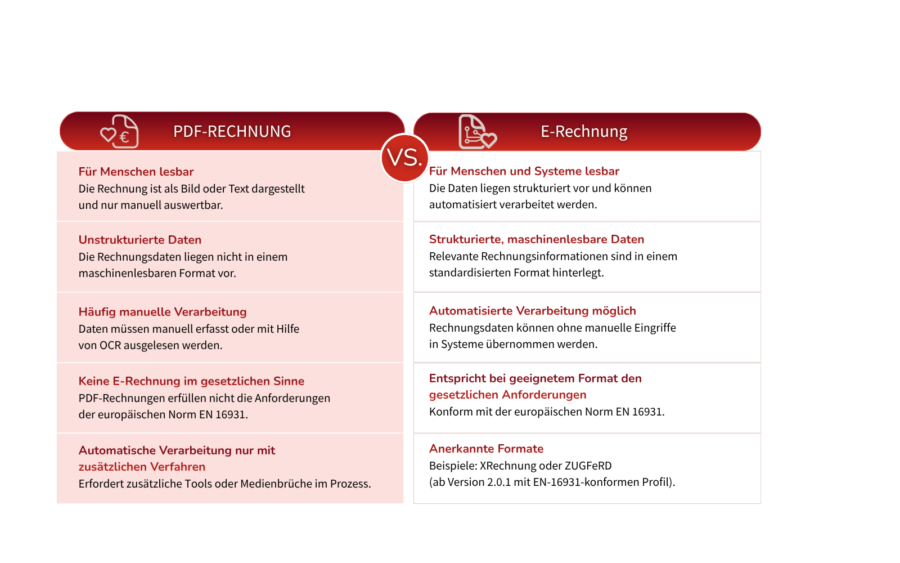
Many companies still believe that a PDF file sent by email counts as an electronic invoice.
That was true until the end of 2024.
However, a new definition has been in effect since 2025. A PDF simply contains an image of the invoice. While it can be read by humans, an ERP system must first interpret the content or extract it using OCR. An electronic invoice works differently.
It contains structured data in XML format. This allows systems to automatically retrieve invoice numbers, amounts, tax rates, or payment terms and process them further without manual intervention. Exactly this automated processing is the goal of the legal regulation.
For companies, this means fewer media disruptions, lower error rates, and faster accounting processes.
Not every digital format automatically meets legal requirements.
Currently, the following formats in particular are considered suitable:
Both formats comply with the European standard EN 16931 and enable automated processing of invoice data.
The format used within a company often depends on its business partners and existing ERP systems.
While XRechnung is widely used, particularly in the public sector, many companies use ZUGFeRD because it also includes a PDF version for human readers.
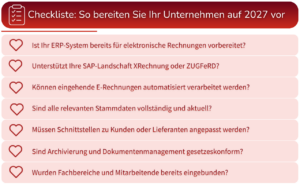
For SAP companies, the transition involves much more than just sending invoices. E-invoicing affects several business processes at once.
These include, among others:
Particularly in established SAP environments, there are often individual developments or integrated third-party systems. These must be configured to be able to generate, receive and process structured invoice data.
Companies that already use SAP S/4HANA often have more modern integration options. However, even in these cases, it is necessary to check whether the existing processes actually comply with legal requirements.
With SAP ECC systems, the need for customization is often greater. In such cases, companies must analyze in detail which components are affected and which enhancements will be required.
Although companies are still permitted to send PDF invoices in some cases during the transition periods, they must generally be able to receive e-invoices from 1 January 2025.
Although a suitable electronic mailbox is sufficient as a means of receiving correspondence, in practice this is rarely enough.
The real challenge lies in automatically verifying and visualizing incoming invoices and integrating them into existing ERP processes. This offers considerable potential for greater automation, particularly for companies with high volumes of invoices.
The technical transition is only one part of the project. In practice, further challenges often arise.
These include, for example:
Furthermore, invoices today often cannot be viewed in isolation. They form part of an end-to-end digital process – from the order through to delivery and finally to accounting.
Therefore, it is worth viewing the introduction of e-invoicing not as a mandatory project, but as an opportunity to modernize existing processes.
Starting early reduces risks and avoids last-minute rushes.
For many companies, the 2027 e-invoicing requirement marks the next important milestone on the path to the full digitalisation of invoicing processes.
Companies with a revenue of more than 800,000 euros in the previous year should make use of the time remaining to adapt their systems and processes in good time. Those using SAP should not only consider the technical aspects of generating electronic invoices, but should also take a comprehensive view of the entire end-to-end process.
Early preparation reduces project risks, provides planning certainty and ensures that legal requirements can be met without time pressure.
The roll-out began on 1 January 2025. For many businesses with a turnover of more than 800,000 euros in the previous year, issuing electronic invoices will become mandatory from 1 January 2027. For smaller businesses, the transition period ends at the end of 2027.
Common formats include XRechnung and ZUGFeRD in versions compliant with EN 16931.
No. From 2025, a PDF on its own will no longer be considered an e-invoice. A structured electronic format that can be processed automatically is required.
SAP organisations should review their invoicing processes, interfaces, master data and integrations. Depending on the version of SAP in use, various technical adjustments may be required.

Register now for free and receive smart tips on output management, SAP forms, customizing, webinars, and more once a month!
You are currently viewing a placeholder content from Hubspot Embedded Content. To access the actual content, click the button below. Please note that doing so will share data with third-party providers.
More InformationYou are currently viewing a placeholder content from HubSpot. To access the actual content, click the button below. Please note that doing so will share data with third-party providers.
More InformationYou are currently seeing a placeholder content of HubSpot Meetings. To access the actual content, click on the button below. Please note that data will be passed on to third-party providers.
Further information