SAP e-invoice

SAP Output.
E-invoices that think ahead.

Product solutions Forms

Send e-invoices worldwide from SAP – without inventing every country from scratch

With the Global E-Invoice Cloud, you can integrate new countries, formats and transmission channels in a matter of days rather than months – without the need for in-house development, additional SAP transports or a constant stream of new stand-alone solutions.

Our managed SaaS solution takes the strain off your IT department, provides transparency for the finance team and keeps your SAP system streamlined and future-proof.

Request your free initial consultation now

Find out more about the Readiness Workshop

E-invoicing in SAP – challenges and solutions.

With every new country come new requirements regarding invoice formats, validation, transmission methods and archiving. What initially appears to be a single regulatory requirement quickly becomes an ongoing task for IT and Finance.

for finance that means

  • keeping track of country-specific requirements and deadlines
  • identifying incorrect or rejected invoices in good time
  • tracking the delivery status at any time
  • fully archiving invoices and related information
  • co-ordinating new requirements with IT and service providers

for IT, this means

  • operating additional interfaces and local solutions
  • long-term maintenance of in-house development
  • transfering new requirements to the SAP system
  • building up expertise on different countries and providers
  • allocating limited resources to regulatory matters

The real problem is not the first country – but every following one

Many companies tackle e-invoicing on a country-by-country basis. Under time pressure, this leads to local interfaces, a variety of providers and bespoke solutions.

In the short term, this ensures that legal deadlines are met. In the long term, however, complexity increases: every further roll-out requires new expertise, additional coordination and further technical adjustments.

That’s how a quick fix gradually turns into an expensive and high-maintenance system landscape.

“If we try to sort it out ourselves, we’ll end up killing ourselves.”

Integrating new countries in days rather than months

It usually takes around two hours to set up the technical connection between an SAP system and the Global E-Invoice Cloud.

Our real-world projects demonstrate just how quickly the entire implementation process can be completed: customers went live within six weeks, from the project kick-off to the first e-invoice being sent out.

The result: a centralised e-invoicing process that not only meets current requirements but is also prepared for the next countries.

Our references

Companies that rely on solutions from Softway AG.

SAP e-invoice

The Remmers Company

With the Global E-Invoice Cloud, Remmers was able to transform the e-invoicing process from a regulatory requirement into a strategic component of its digital transformation. Thanks to a centralized solution and the self-service capabilities of individual departments, the system can be rolled out to additional countries on a phased basis.

View reference
about 1,600 employees Construction chemicals, wood paints and varnishes, industrial coatings 18 subsidiaries across Europe
SAP e-invoice

Masa Group

With the Global E-Invoice Cloud, the Masa Group has seamlessly integrated legally compliant e-invoice processing into its existing SAP environment. The scalable solution automates processing, validation, and archiving, creating a future-proof foundation for further international rollouts.

View reference
500 employees Custom Machine Building / Stone Industry worldwide

Simplify rather than complicate further

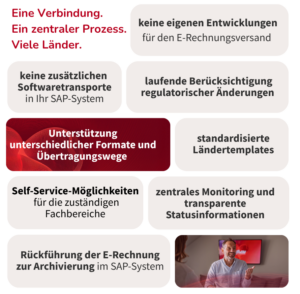
With the Global E-Invoice Cloud, you can adopt a centralised, internationally scalable approach to sending e-invoices from SAP.

New countries are integrated using standardised country templates. Country-specific formats, validations and data transfer routes are managed outside your SAP core system.

This means you do not have to develop a new solution in your SAP system for every country.

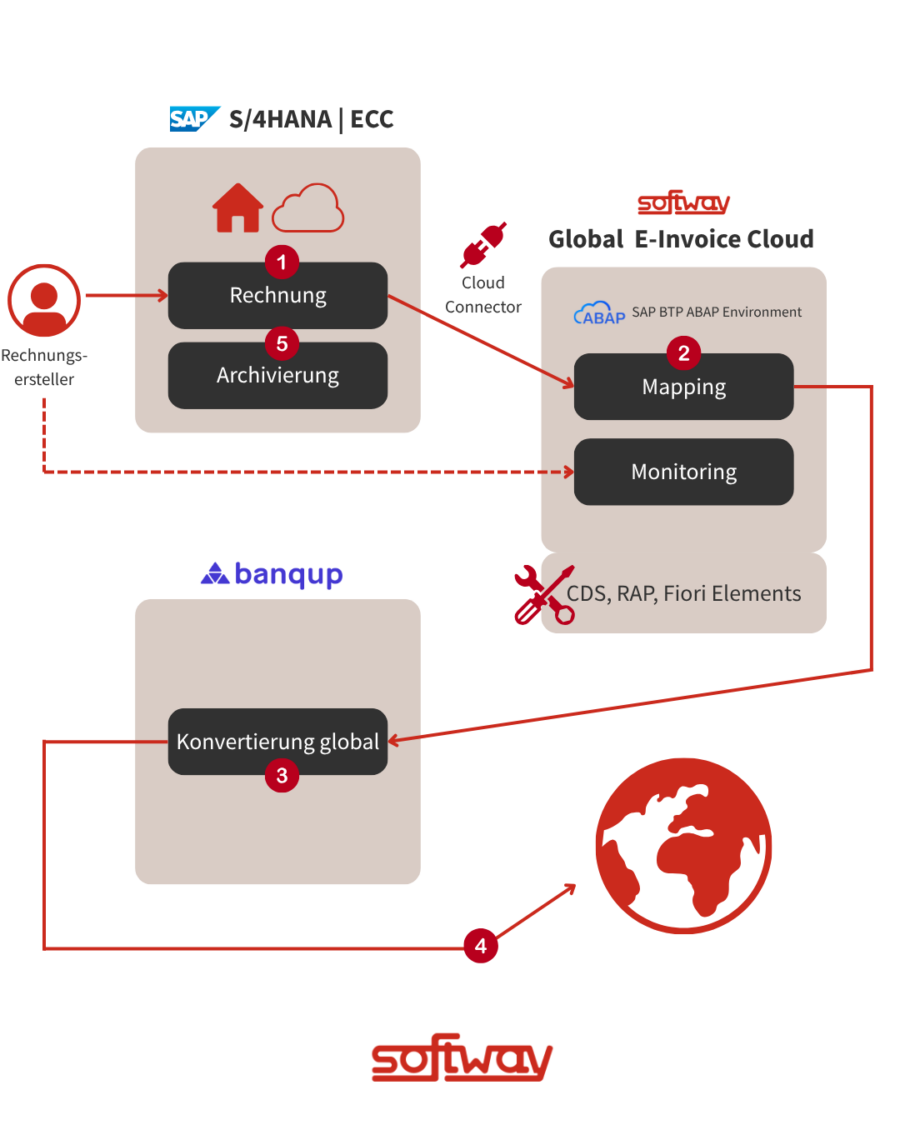
Global E-Invoice Cloud process

Architecture Global E-Invoice

  1. Invoice is created and sent to the Softway Global E-Invoice Cloud.
  2. The invoice is received, the data is mapped and sent to the banqup Group.
  3. Invoice is converted into the respective country-specific format (e.g. XRechnung, ZUGFeRD).
  4. Invoice is transmitted to the invoice recipient as an XML file via the defined transmission channel (e.g. e-mail, PEPPOL).
  5. Invoice is archived as an XML file | ZUGFeRD PDF in the country-specific format on the SAP invoice.

A joint process for IT and Finance

Advantages for your IT

  • A light SAP core based on the Clean-Core principle
  • reduced development and maintenance expenses
  • no own SAP BTP required
  • fewer interfaces and local isolated solutions
  • rapid connection to additional countries
  • more time for strategic SAP issues

Advantages for Finance

  • Centralised transparency regarding e-invoice dispatch; automated country-specific validations
  • automated country-specific validations
  • fewer manual adjustments
  • faster response to errors and feedback
  • nachvollziehbarer Versandprozess
  • a better foundation for international roll-outs

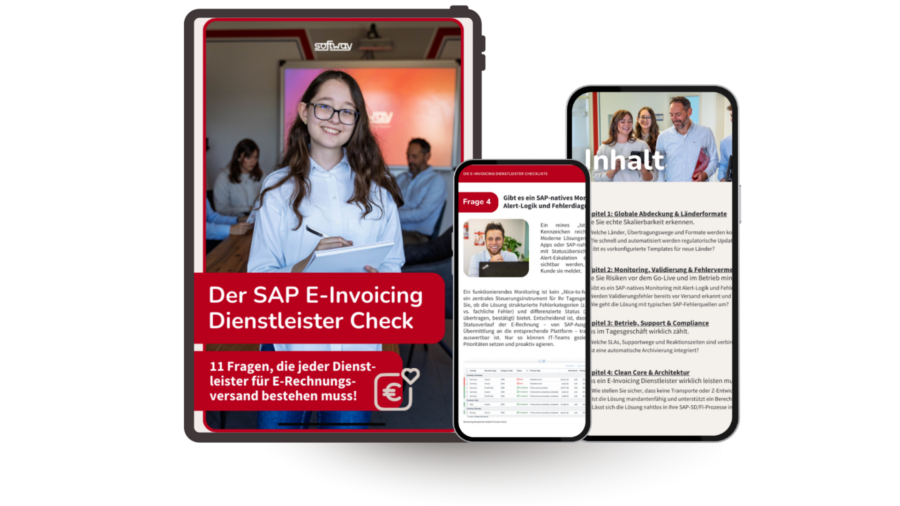
Evaluating SAP e-invoicing service providers: 11 questions (PDF) 👉

For IT teams that want to be globally compliant without resorting to local isolated solutions!

Avoid making the wrong decisions that will hinder scalability, the Clean Core approach and compliance in the long term.

11 konkrete Fragen, die jeder Dienstleister für den E-Rechnungsversand bestehen muss.

Download now for free

Are your processes ready for the next e-invoicing market?

In the Readiness Workshop, we work with IT and Finance to analyse how well your company is prepared for sending e-invoices.

In doing so, we review, amongst other things:

  • existing invoicing processes and SAP systems
  • relevant countries, companies and accounting scenarios
  • master data and technical requirements
  • Invoice forms and required information
  • existing interfaces and dependencies
  • organisational responsibilities
  • a specific need for action and implementation

Following this, you will receive detailed documentation containing a transparent estimate of the work involved and specific recommendations for action – regardless of whether you subsequently choose to carry out the implementation with us.

Request a Readiness Workshop now

Let’s talk about your e-invoicing process

During a non-binding initial consultation, we will discuss the following together:

  • Which countries do you need to connect to, either now or in the future?
  • What does your current invoicing process in SAP look like?
  • Where do manual tasks or technical dependencies arise today?
  • What might a centralised, scalable solution look like?

You are currently seeing a placeholder content of HubSpot Meetings. To access the actual content, click on the button below. Please note that data will be passed on to third-party providers.

Further information

FAQ: Everything you need to know about SAP e-invoices with Softway AG.

No in-house developments or additional software transfers are required for Global E-Invoice. Cloud required. In your SAP system, the following is used: We have carried out standard customisation and – where necessary – worked with SAP standard objects.

Yes. The solution is designed for international roll-outs. Additional countries, formats and transmission methods can be added using standardised country templates.

Yes. The Global E- Invoice Cloud can be used both in existing SAP environments and in conjunction with SAP S/4HANA.

No. To use Global E- Invoice Cloud, you do not need your own SAP BTP.

Country-specific requirements are reviewed regularly and any necessary adjustments are made centrally in the Managed SaaS-Solution provided. This reduces the internal maintenance and coordination workload

During an initial, non-binding consultation, we will first assess your current situation. If a more detailed analysis is required, we will then carry out a structured review of your processes, data and technical requirements in the ReadinessWorkshop.

consultation